
You are here
Rainy's last doctor done in April: Singleton cites funding models as problem
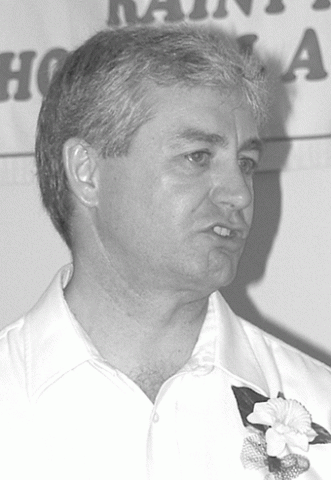
Editor's Note: We receieved this letter to the editor yesterday. We did inquire with Riverside Health Care Facilities and with our MPP Sarah Campbell as to their comments or word on a plan for Rainy River's Health Centre once Dr. Singleton is done on April 16, 2012 instead of his earlier date of June 2013. No comments from Riverside were received at press time.
Here is what Campbell said Tuesday:
"This is terrible news for the community. I have just been made aware of the situation, but they can be rest assured that this is my number one priority and I will act on it immediately. I have acted in good faith and have attempted to work with the Minister while raising concerns about the flaws in the system that Dr. Singleton has raised in his letter. Unfortunately, to date the Minster has not responded with any meaningful solutions. I will be asking for her to address this issue immediately and I will use all tools at my disposal to get an immediate response."
Dear Editor:
As many of you know, I originally gave notice of my intention to resign as a contract physician in early January of this year, with an effective date of June 30th, 2013. The reason for the resignation was that I wished to have more control over my work and its conditions. The amount of notice was to give the community a generous amount of time to recruit a replacement.
Unfortunately, I now feel I must move this date forward. I am writing to explain the reasons for this decision.
Anyone who has heard me speak about the Locum House will know that the problem here, and in many other small communities, is finding replacement (locum) doctors to cover time away for continuing medical education, respite and personal leave. Where there is a 24-hour Emergency Room being run by only two doctors, the situation is particularly precarious. Dr. Beller and I endured the problem for years, and this community, even when fully staffed, was never more than one doctor away from a potential crisis. That crisis is upon us now, when the loss of one doctor has caused the need for extraordinary efforts to keep the ER open. As the physician on the front line, I am acutely aware that, even if we were successful in recruiting two new physicians, the needs of the community would still not be met.
The basic working arrangements here are excellent, the staff is superb, and there was stable medical staffing for years. So the first question is, why has no doctor seriously considered coming here permanently, when there has been a vacancy for eight months? It has become clear to me that the answer is in the deficiencies of the funding model. We are unable to compete with the higher pay offered in larger centres. The kind of doctor required here is a generalist who can function comfortably alone in an emergency room: these doctors are hard to find and are going instead to places - both permanently and temporarily - where the pay scale is higher. In short, the remuneration here is not competitive.
The second question is, why are we still experiencing such difficulty attracting locums relative to other larger centres? The answer again is the deficiencies of the funding model. We can attract the required coverage, but not consistently. It is only when the Ministry of Health (MOH) authorizes significantly more money to the locum as an incentive that the difficult-to-cover periods are looked after. The Ministry has been doing this, but waiting until the last possible moment to authorize it. It is an ever-present possibility that the time will come when no last-minute coverage can be arranged. That’s taking chances with your access to emergency health care here, and it’s a bandaid solution. It is also unreasonable to expect any staff physician on the ground here to stand by and tolerate this way of handling things.
The change to the funding model that is required would put us on a level playing field with other communities in terms of attracting locums. This would in turn attract doctors to come here permanently, because they would know their leave needs would be covered. It also appears that it is now needed to attract applicants for the permanent positions.
While we are all hearing that the provincial budget, and the budget for health care in particular, is now a pressing issue, it seems appropriate to me that priority should be given to delivering stable primary and emergency care, which is exactly what we are talking about here. This little community’s basic care is the wrong place for the province to start holding the line. And especially not when there has been an extraordinary local effort to fund the Locum House, and thereby help support our own services.
Other physicians and I have made it clear to the Ministry of Health that we believe the current funding model is our primary problem. It appears that the response of the MOH is to see if the problem will go away by itself, and to hope, whenever there is a looming shortage of manpower for the emergency room, that at the last moment a doctor will be enticed to cover it. I am forced to conclude the MOH has no interest in fixing the problem. In that case, no amount of notice from me will be helpful.
I would like to think that my resignation, which is now effective 16th April 2012, will be a call to the Ministry to do the right and responsible thing for the citizens of this area by putting a lasting solution into place. I am fully prepared, otherwise, to be unemployed in two months. I wish to reassure this and surrounding communities that I believe the clinic, emergency room and hospital will remain open, but staffed by a revolving door of locum physicians paid for probably out of the two unclaimed salaries, augmented as required by other resources the MOH has available. Continuity of care will suffer, and stability of the manpower situation will remain problematic for the foreseeable future.
I have made it clear that if the problems here are properly addressed, I will reconsider the date of the resignation. I continue to believe that this clinic and hospital are good places to work, and this is because of the professionalism and commitment of the people working there.
–Sincerely,
Dr. David Singleton