
You are here
Bill 102 could see small town pharmacies fold up
By Ken Johnston
Editor
If you have not heard of Bill 102 you might want to pay attention to this story.
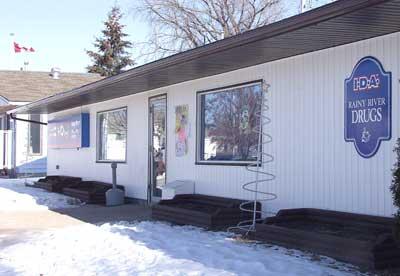
Rainy River Drugs Pharmacist Sarah Berg was not even aware of this provincial bill until after second reading last year. Since then it has been read the required number of times and passed. It is set to go into effect March 1, 2007 and Berg along with many other smaller independent pharmacies are very concerned about their businesses’ very existence down the road.
Bill 102 is the provincial government’s Transparent Drug System For Patients Act. While it sounds like it will be good for patients, promising to bring down the exploding costs of drugs, especially in the seniors population with all the baby boomers getting to that age, it could be devastating for smaller “Mom and Pop” drugstores.
Berg said that the bill will change the way she makes her living at the pharmacy. While drug costs have gone up by 150% for the province’s Ontario Drug Benefit Plan in the past ten years, Berg said pharmacists have only been allowed a 2% increase in dispensing fees under the new plan. “We have not increased dispensing fees in 21 years here,” she added. “How many businesses can say they have done that.”
Before Bill 102, pharmacies were allowed to mark up drugs by 10% over what they paid for them. Now the government is rolling that back to 8% and also allowing the wholesalers to charge a 5.6% surcharge on the price of the meds. That takes the 8% mark up and guts it to 2.4% for pharmacies.
Another problem with the 8% mark up is that it can not exceed $25. In otherwords there is a cap of $25. Berg said that on any prescription over $312.50 she will be taking a loss. For example she currently fills an expensive prostrate prescription eight times a year for two patients. Each time she fills it she will lose $98. That is $784 loss per patient per year.
At the back end of the business, the pharmacies used to be able to get price rebates through direct negotiations with generic drug companies. The province has stepped in and cut those rebates by 50%. “They are doing this because they want to say what the rebates are spent on,” said Berg last Thursday.
Plus, changes in the law will see a two tiered pricing system on generic drugs. Anyone on a private insurance or paying cash will pay more for their drugs than those on the Ontario Drug Benefit plan. “It will be approximately 16% less for ODB patients,” explained Berg.
That means she will have to carry two inventories of generic drugs. One priced at one level and the other at the higher amount. Plus the province will be negotiating directly with the generics and making all ODB orders go through a warehouse in Brampton. “That means a possible three day wait to fill those scripts if we are out of the drug,” said Berg. At present it is a one day wait as the meds come from Manitoba. And if she has the drugs in one inventory but not in another they can not be swapped into the other stream.
As of March 1st Berg projects she will lose between $10,000-$15,000 on her inventory alone. “I will have to sell drugs at a lower price than I did before that date, and had to buy them at a higher price before that date.”
Berg currently has three full time and five part time staff working for her at Rainy River Drugs. If her revenues drops, like she thinks they will, she may have to lay off staff, and after six months, if she is bleeding too much red ink, she may have to close the store. “I hope I don’t have to close but I can’t stay open losing money.” She took over the store about five years ago and having grown up here she would like to stay here, but knows she can go elsewhere and make a good living.
Berg said the Ontario Pharmacists Association is predicting that 10% of all Ontario pharmacies will go out of business because of this, and of those 85% will be in one pharmacy towns like Rainy River and Emo. She noted the big box stores like Walmart and Safeway can afford to run their pharmacies at a loss and keep them open.
If Rainy River and Emo were to close, the closest pharmacy would be in Fort Frances.
Berg had this to say about the entire situation, “The Ministry of Health went about this entirely the wrong way. They should have talked to us. Pharmacists are probably the best people to consult on ways to save money. I myself can think of at least a dozen ways to cut costs.”
Berg urges the public to call Howard Hampton, the local MPP at 274-7619 and express their concerns. Hampton’s wife, Shelly Martel, an MPP from the Sudbury area, has been very vocal about concerns for smaller pharmacies future after this bill goes into motion.
In debate over the bill last spring, government member of parliament Tim Peterson said, “Let me assure the House that in the extensive consultations that were undertaken in the preparation for this bill, they consulted heavily with all levels of pharmacies. The role of the smaller pharmacies, the backbone of our rural communities, the backbone of our small communities, who often serve as alternative consultants to people’s health care needs, will be appreciated and they will be rewarded because they will have increased dispensing fees and they will be given professional service fees for the consultations they undertake. This will help impact any negative effect of the reduction of these rebates or other fees in dispensing of the drugs. We are hopeful and positive that there will be very little negative impact, especially to smaller drugstores.”
According to Martel the problem will not be limited to small communities. She read from a letter by Medi Place Pharmacy, which is on Bloor St. in Toronto. “For years, pharmacies and particular community pharmacies who are unable to compete with the larger players have been subsidizing Ontario’s health care system. We have done everything to stay in business, from waiving the $2 co-payment fee to lowering our prices. Now, by taking away the rebate offered to us by generic manufacturers, the province is essentially telling us that community pharmacies are not important to them. We have been subsidizing Ontario’s drug system for years, but it is simply impossible to — overnight — have our operating profits and the value of our business cut by half or more...(Bill 102) as it stands, will result with most independent pharmacies not being able to meet their bottom lines forcing them to close. The final result will be a pharmacy industry being operated by large chains.”