
You are here
Dinosaurs among us pt. 2
Editor's Note: This is part 2 in a 2 part series.
By Jack Elliott
Correspondent
Lake Sturgeon an Ontario Perspective
The latest check with Customs and Immigration reveals the Lake Sturgeon population in the Rainy River Basin have not been checking in when crossing the Canada/US boundary. This could all change for this shared resource.
This may be a bit ‘tongue in cheek’, but the MNR are operating and planning more research programs on the lake sturgeon, states Ontario Ministry of Natural Area Biologist John Vandenbroeck at the Fort Frances. Vandenbroeck working with the Rainy River/Manitou team is investigating several aspects of lake sturgeon behavior in the Rainy. This summer they will be studying ‘larval drift associated with spawning’ as relates to temperature and flow, an important, but imperfectly understood aspect of the lake sturgeon life cycle. The Larval Drift Project is a joint project between MNR and Department of Fisheries and Oceans
Sturgeon in the Rainy Basin spawn erratically year to year, as well as within the year, in different locations of the watershed. These differences appear to be related to different temperatures and flows within the watershed. For instance the water immediately below the dam at Fort Frances in the spring is considerably cooler than water downstream from Emo. As well it appears sturgeon spawn in two waves at the same location, separated by a matter of weeks, perhaps an evolved behavior to ensure successful reproduction in response to a varying environment. Questions that need to be answered like the effect on sturgeon and successful spawning, of a low water year such as this or the impact of opening the weirs during high water release, are just some of the goals
Vandenbroeck and his team will be collecting larval spawn in a series of nets this spring following the hatch, in hoop-shaped nets that will collect anything above 1000 microns. The nets will be located just downstream of the Fort Frances dam and the public is asked to please avoid the nets, or disturbing their location. Notices will be posted near the site. Additional equipment collecting data on water flow and temperature will be located at the netting sights
“This year we are looking at getting the kinks out of the collection system, before expanding the sampling to additional locations along the river,” explained Vandenbroeck, detailing the program.
“We also currently have active data loggers collecting water flow and temperatures at other points down river, “ he added.
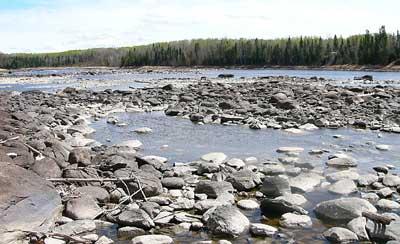
Do the same lake sturgeon spawn at the same location or do other factors effect their choice. Vandenbroeck suggested future studies may be conducted to determine movement of individuals within the Rainy. This could be accomplished using data loggers placed at several locations along the waterways to track individuals’ movements. Interest in this aspect of the populations movements and choice of spawning locations has been further heightened by this years low water levels that has left much of the Long Sault Rapids exposed and the mouth of the Rapid River at Clementson with negligible sturgeon activity the last weeks- both major sturgeon spawning areas most years.
The sport fishery for lake sturgeon in Ontario waters is pretty much limited to catch and release, plus a modest subsistence catch. Regulations are changing in respect to open season and clarification on allowable trophy fish will be published in the 2008 Ontario Guide. The 45 inch “dressed fish” minimum size has been translated to a total fish length number 75” which is pretty much equal to the record angling catch in Minnesota. The Rainy River First Nation currently holds the only commercial lake sturgeon quota on the Lake of the Woods-Rainy River system, but it is not being exercised due to a self-imposed commercial fishing moratorium. Subsistence harvests by First Nations are generally around 1000 lbs annually.
While we are a long way from, if ever, becoming the caviar capital of the world, we are very fortunate to have a healthy lake sturgeon fishery. Properly nurtured it will be here for all to enjoy. And nothing can quite excite any angler as much as having a dinosaur roll up beside your boat, break your line, and with a flip of its tail disappear into the murky depths.
Current Lake Sturgeon Regulations
Ontario
Minnesota
Open Season
Jan-May 15
Harvest* April 24-May 7
Closed Season
May 16-June 30
May 16 - July 30
Open Season
June 30-Dec 31
Harvest* July 1-Sept 30
Catch & Release Only
-May 8-15
-Oct 1-Apr 23
Size Limits
Dressed Length 45 inch (114cm)
(approx. 75” overall length)
Overall length
- between 45 and 50 inches
- Over 75 inches
* to harvest or possess Lake Sturgeon in Minnesota you must have a valid Harvest Tag- one per person per year
* Catch & Release may be practiced during the Harvest Season, but species may not be targeted during the closed season
* Ontario residents who obtain a Minnesota harvest tag and wish to import their sturgeon catch into Canada may require special import permits
Photo courtesy of John Vandenbroeck, MNR: P1010470.jpg: “ Long Sault Rapids on the Rainy River is normally a roaring torrent this time of year, but continued drought conditions have reduced it to a collection of exposed rocks with a trickle of water. This location is a favourite lake sturgeon spawning site and it is unclear how water levels will effect spawning success.”